Why Helion’s $465M Fusion Bet Means Africa Must Build Its Own AI Energy Infrastructure Now
How Will GPU Power Consumption Reshape African Tech Hubs?
To understand why this matters to a developer in Yaba or a founder in Nairobi, we must look at the brutal physics of modern computing. The modern AI revolution is built on high-performance silicon—specifically, Nvidia’s H100 and B200 chips. These chips do not just process data; they devour electricity. A single Nvidia H100 GPU has a peak power consumption of up to 700 watts—more than the average Nigerian household uses in a week. When you cluster thousands of these GPUs together to train or even run inference on a medium-sized LLM, the local power demands skyrocket into megawatts. For African builders, high **GPU power consumption** means that deploying AI locally is currently a financial suicide mission. If you are running an AI startup in Lagos and relying on local server infrastructure, your primary operational expenditure isn't talent or cloud APIs—it is the diesel fuel powering your backup generators. This technical bottleneck forces African startups to host their models on AWS, Azure, or Google Cloud servers located in Virginia, Dublin, or Cape Town. This export of data not only increases latency but also drains precious foreign exchange from our ecosystems through perpetual API billing. We are essentially exporting our raw data and importing expensive, foreign-processed intelligence because we cannot power the silicon at home.The High Cost of Powering African AI on Broken Grids
The economics of AI compute are fundamentally different from the software-as-a-service (SaaS) era. SaaS required minimal local hardware; AI requires massive, continuous physical compute. In Nigeria, the recent devaluation of the Naira has sent diesel prices soaring, making local generator-powered data centers economically unviable for high-density AI workloads. In Ghana, utility tariffs continue to climb, squeezing the margins of local tech hubs. Historically, we have seen African tech ecosystems adapt to infrastructure deficits through sheer software ingenuity. We built fintech platforms to bypass physical banks and USSD protocols to bypass poor internet penetration. But you cannot code your way out of a power deficit. If a local data center cannot guarantee 99.999% uptime because of grid instability, the AI models hosted there will fail. The cost of power in African market terms is currently the single greatest tax on local AI innovation. Unless we find a way to lower the cost per megawatt-hour for compute, African AI startups will remain consumer-tier wrappers built on top of American APIs, completely vulnerable to foreign pricing changes and policy shifts.Why Africa Must Leapfrog to Off-Grid AI Energy Infrastructure
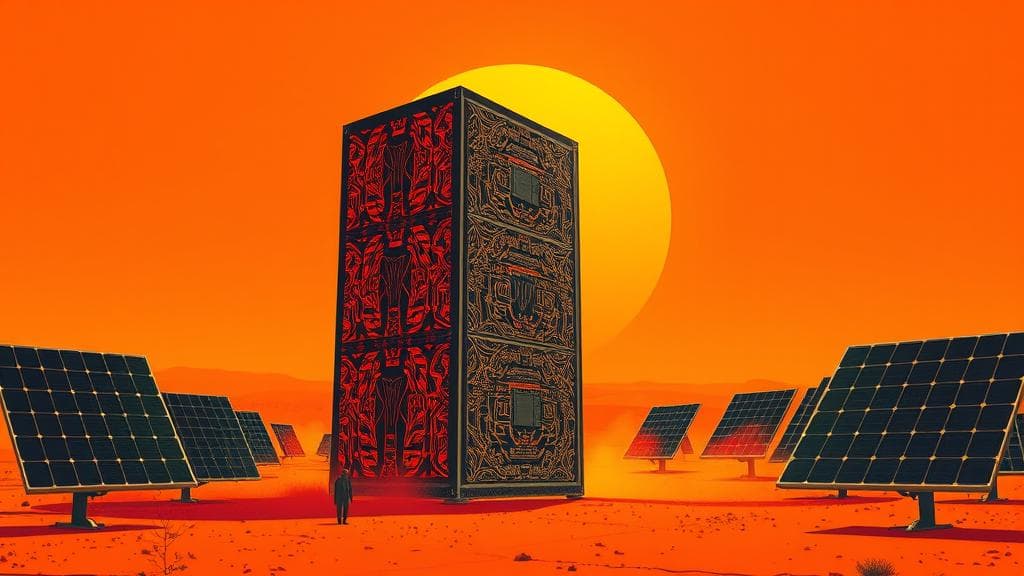
This is where the massive opportunity lies for African builders and energy entrepreneurs. Just as Africa bypassed copper-wire landlines directly to mobile networks, we must now bypass centralized national grids directly to modular, off-grid **AI energy infrastructure**. We cannot wait for state-led transmission lines to be repaired or modernized. The future of African compute lies in building **green data centers** directly co-located with dedicated, renewable energy sources. The continent has an abundance of solar, geothermal, and hydro resources that are currently underutilized. Imagine a future where AI training facilities are built not in crowded city centers like Lagos or Nairobi, but in rural Kenya near geothermal wells, or in northern Nigeria alongside massive solar farms. By deploying **off-grid energy solutions** specifically designed to power modular, containerized data centers, African builders can create localized compute hubs. This is not unprecedented. Companies like Teraco in South Africa are already investing heavily in solar power to shield their data centers from grid failures. We need this model democratized and scaled across West and East Africa, specifically tailored for high-density AI workloads.Is Sovereign African AI a Pipe Dream Without AI Energy Infrastructure?
The contrarian view is simple but painful: without sovereign **AI energy infrastructure**, African tech will remain a digital colony. If we continue to rely entirely on Western cloud providers to run our AI models, we surrender control of our data, our cultural nuances, and our economic security. Western models are trained on Western data; they do not understand the linguistic diversity of Nigeria, the agricultural realities of Ghana, or the informal trade dynamics of Kenya. If we attempt to train local models on foreign clouds, the cost will be astronomical and ultimately unsustainable. The risk of inaction is that we become mere consumers of global AI, paying rent to Silicon Valley giants forever. We must view energy not as a utility problem for the government to solve, but as a core component of the AI technology stack. The founders who succeed in the next decade will not just be those who write the best algorithms, but those who secure the cheapest, most reliable megawatts to run them.People Also Ask
Q: Why does AI require so much more energy than traditional software?
A: Traditional software only requires power when processing specific user requests, but training and running modern AI models requires massive clusters of GPUs to run continuously at peak capacity. This constant, high-density computational load creates massive heat, requiring additional energy for cooling systems, which dramatically increases overall power consumption.
Q: Can African solar power realistically support AI data centers?
A: Yes, but it requires hybrid systems. While solar provides abundant energy during the day, AI data centers require 24/7 uninterrupted power. To make solar viable for AI compute, builders must pair solar arrays with industrial-scale battery storage and alternative backup sources like natural gas or biomass generators.
Q: Why shouldn't African AI startups just use Western cloud providers?
A: Relying solely on foreign clouds leads to high latency, data sovereignty issues, and crippling subscription costs paid in foreign currency (USD). Building local energy-independent compute allows African startups to process data locally, comply with regional data protection laws, and dramatically lower long-term operational costs.
Bottom line for African builders: Stop waiting for the national grid to stabilize; the future of African AI belongs to those who build sovereign, off-grid compute powered by local renewable energy.
This digest was compiled from:
- https://old.disruptafrica.com/2024/01/22/egyptian-e-health-startup-yodawy-banks-10m-funding/
- https://ventureburn.com/helions-465m-raise-signals-growing-fusion-demand/
- https://ventureburn.com/ramp-hits-44b-valuation-in-750m-ai-focused-funding-round/
- https://ventureburn.com/alphasense-raises-350m-at-7-5b-valuation/
- https://ventureburn.com/tishman-speyer-secures-300m-korea-living-venture-fund/
Share this digest
People Also Ask
- MarkHack 5.0 Launches in Lagos to Address AI Personalisation and the Culture Algorithm
MarkHack 5.0 will gather African innovators in Lagos to explore how artificial intelligence and data-driven systems shape modern consumer experiences.
- Nobel-Winning Economist Daron Acemoglu Shares His AI Concerns
Nobel-winning economist Daron Acemoglu highlights AI agents' limitations and the industry's push to shape the economic narrative around job concerns.
- The Rise of the Silicon Savannah: How Africa is Redefining the Global Outsourcing Market
Africa is emerging as a global outsourcing powerhouse, with seven countries ranking in the top 25 of the Ataraxis Global Outsourcing Talent Index.