Industry7 June 20265 min readAI Generated
UBA Wins Major 2026 Award for AI-Powered Banking Innovation Across Africa
For years, African tech builders have been told that artificial intelligence is a luxury tool for Silicon Valley, but United Bank for Africa (UBA) just proved that **AI-powered banking innovation** is the ultimate weapon for dismantling the borders that choke African commerce. By winning the African category at the 2026 Banker Technology Awards, UBA has demonstrated that integrating conversational AI with cross-border payment rails is no longer a futuristic pilot—it is the active infrastructure of pan-African trade. For developers and founders across Lagos, Accra, and Nairobi, this isn't just corporate PR; it is a structural shift in how money moves across our continent.
Why AI-powered banking innovation matters for Nigeria/Africa
If you are building a startup in West Africa, you know the pain of regional expansion. Moving capital between Nigeria and Ghana shouldn't require routing transactions through correspondent banks in London or New York. Yet, legacy financial infrastructure has forced African businesses to absorb massive exchange rate losses and multi-day clearing delays. This **AI-powered banking innovation** changes the equation by turning a complex financial settlement system into a simple, conversational chat. When a merchant in Lagos can pay a supplier in Kumasi using local currency via an AI chatbot, the friction of cross-border trade collapses. This matters because it democratizes access to regional markets. Micro-merchants and developers do not have the legal teams or capital reserves to navigate traditional cross-border banking. By placing conversational AI at the front end of pan-African payment rails, UBA is lowering the transaction barrier, proving that AI's real value in Africa lies in abstracting complexity for the end-user.What happened: UBA wins global recognition for AI-powered banking innovation
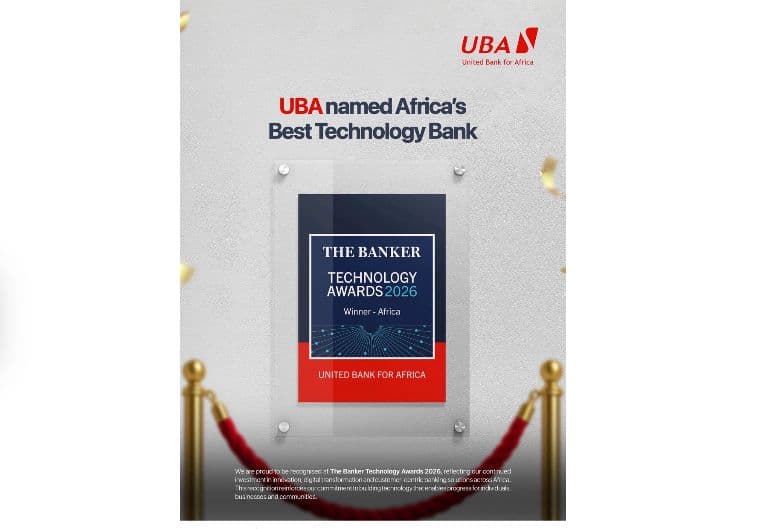
United Bank for Africa (UBA) Plc has been named the winner of the African category at the 2026 Banker Technology Awards. The award recognises UBA’s use of artificial intelligence and digital technologies to drive seamless cross-border banking across more than 20 African markets. The Banker Technology Awards received close to 200 submissions across 17 regional and product categories this year, highlighting a global shift toward embedding technology directly into payments, compliance, and customer engagement. In its official assessment of the winning entry, The Banker noted that “the bank has cemented its status as a leading digital operator by placing technology at the centre of its growth strategy across more than 20 countries, with this approach most visible in its work on cross-border transfers, spanning digital payments, AI-driven engagement, and e-business.” The core of UBA's winning strategy is the integration of its AI-powered chatbot, Leo, with the Pan-African Payment and Settlement System (PAPSS). This integration allows customers to send funds across borders in local currencies using a conversational interface. Emmanuel Lamptey, UBA’s Executive Director Designate, Digital Banking, received the award on behalf of the bank and laid out a clear vision for the continent’s financial systems. "Africa's financial future will not be built on branches or borders. It will be built on intelligence, interoperability, and trust at scale," Lamptey said. He added that the bank's heavy investment in Leo was a direct response to the historic inefficiencies of regional trade: "Across a continent where cross-border transfers have historically been slow and costly, Leo reduces friction at the point of transaction, removing reliance on traditional banking channels without requiring customers to change how they communicate." Simultaneously, UBA has relaunched its RedApp mobile banking platform following a comprehensive upgrade aimed at delivering a faster, cleaner user experience. Alero Ladipo, UBA’s Group Head, Brand, Marketing and Corporate Communications, stated: "At UBA, we are constantly raising the bar on what digital banking should feel like. The new RedApp is faster, cleaner, and built around how our customers actually live and bank."AI-powered banking innovation and the bigger picture for Africa
To understand the magnitude of this development, we must look at the underlying rails. PAPSS was designed to save Africa over $5 billion annually in payment transaction costs. However, infrastructure is only as good as its adoption rate. Historically, complex banking portals and bureaucratic processes have kept small businesses from using these regional payment rails. This is where **AI-powered banking innovation** acts as an essential bridge. By using conversational AI, UBA is meeting the African consumer where they already are—in chat interfaces. UBA is uniquely positioned to scale this. With 25,000 employees, 45 million customers globally, and operations spanning 20 African countries, the bank has the capital strength and distribution network to turn this AI integration into an industry standard. Yet, we must look at the contrarian risks honestly. Conversational AI in African banking faces steep operational hurdles. First is the issue of linguistic localization; while Leo is highly capable, Africa's linguistic diversity—including localized pidgins and informal market dialects—remains a challenge for natural language processing models. Second, the system relies on stable telecommunications infrastructure. In regions plagued by network downtime, a conversational transaction can hang, leaving users in limbo. Finally, security remains a critical concern. Conversational interfaces are highly susceptible to social engineering attacks. If bad actors find ways to exploit conversational AI prompts to bypass verification steps, the trust required to scale this system will evaporate. If UBA cannot guarantee low-latency performance and ironclad security across all 20 markets, this innovation risks becoming an elite tool rather than a mass-market solution.What's next for AI-powered banking innovation in Nigeria/Africa
The immediate next step is the competitive response. UBA’s victory at the 2026 Banker Technology Awards will likely trigger a race among other tier-1 African institutions—such as Access Bank, GTBank, and Standard Bank—to deeply integrate their own AI agents with regional payment networks like PAPSS. For African software developers and fintech founders, this is an invitation to build. The future belongs to those who can build niche applications that hook into these conversational banking APIs. Instead of trying to build proprietary payment rails from scratch, builders should focus on creating specialized business-to-business (B2B) tools, localized customer service layers, and micro-transaction platforms that leverage UBA's established AI infrastructure. We must also closely monitor the rollout of the newly upgraded RedApp. Its success across diverse, low-bandwidth environments will serve as a benchmark for whether legacy banks can deliver modern, high-performance software to millions of users without sacrificing system stability.Bottom line for African builders: Stop trying to build closed payment loops; the future of African fintech lies in building conversational AI layers that sit on top of unified, pan-African rails like PAPSS.
#industry#ai#digest#auto
This digest was compiled from:
- https://www.premiumtimesng.com/promoted/885798-uba-wins-2026-banker-technology-award-for-ai-innovation-launches-upgraded-mobile-app.html
- https://aibase.ng/ai-news/uba-wins-2026-banker-technology-award-for-ai-powered-banking-innovation/
- https://www.premiumtimesng.com/news/more-news/885811-panic-as-eriksen-collapses-during-denmark-friendly.html
- https://theeagleonline.com.ng/denmarks-eriksen-collapses-again-during-international-match/
- https://aibase.ng/ai-analysis/top-advantages-of-artificial-intelligence-in-modern-business/
Share this digest
People Also Ask
- MarkHack 5.0 Launches in Lagos to Address AI Personalisation and the Culture Algorithm
MarkHack 5.0 will gather African innovators in Lagos to explore how artificial intelligence and data-driven systems shape modern consumer experiences.
- Nobel-Winning Economist Daron Acemoglu Shares His AI Concerns
Nobel-winning economist Daron Acemoglu highlights AI agents' limitations and the industry's push to shape the economic narrative around job concerns.
- The Rise of the Silicon Savannah: How Africa is Redefining the Global Outsourcing Market
Africa is emerging as a global outsourcing powerhouse, with seven countries ranking in the top 25 of the Ataraxis Global Outsourcing Talent Index.