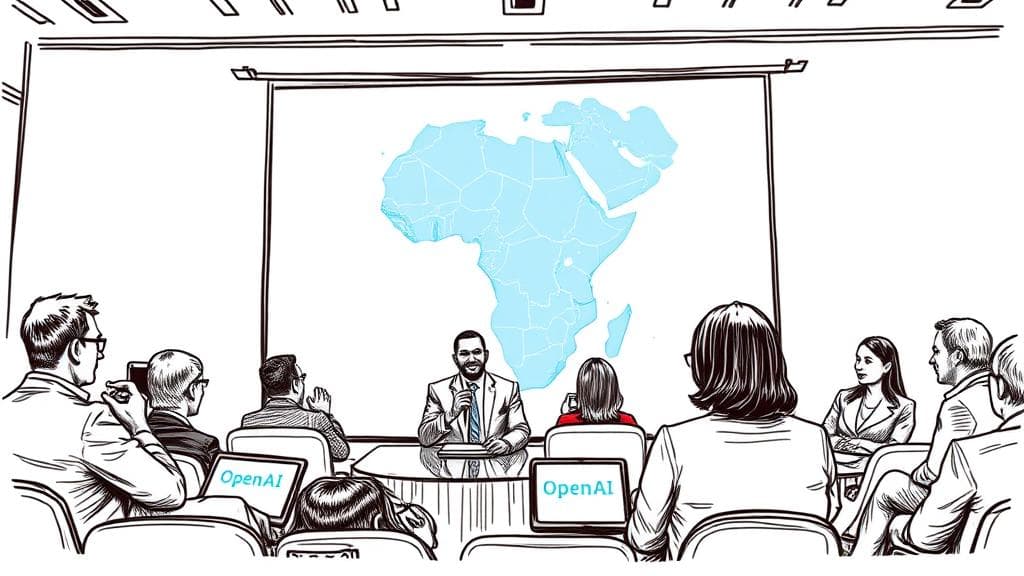
How Frontier AI Governance Will Shape the Future of Global Tech Ecosystems
Why OpenAI’s Blueprint for Frontier AI Governance Matters to Emerging Markets
OpenAI’s newly unveiled public policy agenda focuses heavily on safety, youth protection, workforce transition, and global standards. Historically, OpenAI has transitioned from open-source ideals to a highly guarded, commercial-first model, and this policy agenda is their attempt to institutionalize this gatekeeping. By advocating for global AI safety standards that align with their own internal safety frameworks—such as their alignment research and Preparedness Framework—they are setting up a system where compliance requires heavy auditing and massive capital. Pro-innovation advocates argue that setting clear global standards prevents catastrophic failures and builds the trust necessary for enterprise adoption to scale. However, the cost angle is steep: compliance with these safety standards requires heavy auditing, which only well-funded tech giants can afford, threatening to shut out smaller players in developing markets.For African developers and builders, this means that Western-centric safety compliance requirements will inevitably filter down to API access terms, making it harder for bootstrapped African startups to access top-tier models without costly legal overhead.
Can Global Standards for Frontier AI Governance Prevent a New Digital Divide?
OpenAI’s specific blueprint for U.S. governance of frontier AI proposes a federal framework focusing on safety, resilience, and national security. This is a direct play to align AI development with national interests, leveraging America's capital strength and infrastructure. The contrarian case is obvious: by framing frontier AI as a national security asset, the U.S. risks creating a closed ecosystem that locks out global builders. We saw this with historical semiconductor export controls; a similar "compute curtain" could easily fall on AI. If safety rules become synonymous with national security restrictions, access to state-of-the-art models will be heavily policed.African builders must prioritize building on top of open-source models and regional compute infrastructure to hedge against the risk of sudden geopolitical access restrictions on proprietary American APIs.
How Does HuggingFace's MCP Integration Redefine Open-Source AI Hardware?
While proprietary giants try to build regulatory walls, the open-source community is building bridges. HuggingFace’s integration of Model Context Protocol (MCP) tools into the Reachy Mini—a humanoid robot platform—is a perfect example of technical depth meeting practical execution. MCP, originally pioneered by Anthropic to standardize how AI models interact with data sources and tools, is rapidly becoming the open standard for agentic workflows. By applying MCP to robotics, HuggingFace is proving that open-source interoperability can bypass proprietary gatekeepers entirely. The productivity angle here is massive: developers no longer need to write custom integration pipelines for every new robot or tool; they can use a unified protocol to connect models to physical actuators and external databases.African roboticists and IoT developers should immediately adopt the Model Context Protocol (MCP) to build highly interoperable, low-cost hardware solutions that can easily swap underlying AI models without being locked into a single vendor.
Is the Expansion of Codex Plugins the Ultimate Productivity Engine?
OpenAI is doubling down on Codex plugins, sites, and annotations designed to embed AI directly into the workflows of analysts, marketers, designers, and investors. This is a direct evolution of OpenAI's developer ecosystem strategy, which began with their initial API release in 2020. The goal is clear: lock users into an all-encompassing productivity suite where AI is not just a chatbot, but the cognitive layer of every software tool. The technical depth here lies in semantic parsing and context-aware execution. While critics argue this over-reliance on AI productivity tools could lead to cognitive decay or security vulnerabilities through prompt injection, the sheer productivity gains—slashing task completion times by up to 50%—make adoption inevitable.African tech startups should focus on building hyper-localized Codex plugins and custom integrations that address specific regional business workflows, rather than trying to build foundational models from scratch.
Can Google’s AI Search Tools Transform Informal and Second-Hand Economies?
Google is integrating advanced AI tools into Search and Shopping to help users discover second-hand, thrift, and vintage items. While this sounds like a consumer-facing play, it represents a massive underlying shift in visual search and structured data processing. Google’s Multimodal AI models are now capable of indexing highly unstructured, non-standardized inventory—the exact kind of inventory that dominates informal markets globally. Historically, Google's search dominance has relied on highly structured web data. By mastering the chaotic, unstructured data of thrift shopping, Google is unlocking a massive new frontier for e-commerce.African e-commerce builders should leverage visual search APIs and multimodal data structuring to digitize and scale local informal markets, which operate on the same unstructured dynamics as global thrift shopping.
The Contrarian Case: The Perils of Regulatory Capture and Compute Monopolies
Let's be honest about the risks. While OpenAI’s push for "safety" and "governance" is packaged as altruism, it smells heavily of regulatory capture. By advocating for complex licensing regimes and strict federal oversight, incumbent giants are effectively pulling up the ladder behind them. We have seen this playbook before in the financial and pharmaceutical sectors: heavy regulation favors the massive capital reserves of incumbents while strangling bootstrapped innovators. If the cost of compliance for deploying a frontier model becomes millions of dollars in audit fees, open-source innovation will be criminalized or relegated to the shadows. This is not just a theoretical risk; early drafts of the EU AI Act and US Executive Orders already show signs of stifling open-source developers who lack the legal departments of Microsoft or Google.People Also Ask
Q: What is frontier AI governance and why does it matter?
A: Frontier AI governance refers to the regulatory frameworks, safety standards, and policies designed to oversee the development of highly advanced AI models. It matters because these rules will determine who can legally build, access, and deploy powerful AI technologies globally.
Q: How does the Model Context Protocol (MCP) benefit AI developers?
A: The Model Context Protocol (MCP) provides an open standard for connecting AI models to data sources and development tools securely. It eliminates the need for custom integration code, allowing developers to build highly interoperable AI agents and hardware systems faster.
Q: Will strict AI regulations hurt open-source AI development?
A: Yes, overly complex regulatory compliance standards can lead to regulatory capture, favoring heavily funded tech giants. Bootstrapped and open-source developers may struggle to afford the mandatory safety audits and licensing fees required by new governance frameworks.
Bottom line: As Silicon Valley attempts to institutionalize frontier AI governance to protect its own market share, African builders must aggressively champion open-source models and interoperable protocols like MCP to maintain their technological sovereignty.
This digest was compiled from:
Share this digest
People Also Ask
- Three Reasons Why DeepSeek's New V4 Model Matters
DeepSeek has released V4, an efficient open-source model that matches top closed-source rivals at a fraction of the cost.
- AI in Sierra Leone Education: A New Era for Learning Outcomes
A groundbreaking trial in Sierra Leone shows AI-powered learning can accelerate student math progress by over a year in just eight weeks, setting a new benchmark for educational technology in Africa.
- Why Gemini Omni is the Ultimate Voice and Accessibility Engine for African Startups
Google's new Gemini Omni model is set to revolutionize accessibility for African startups by enabling real-time, low-latency voice applications in local languages.